
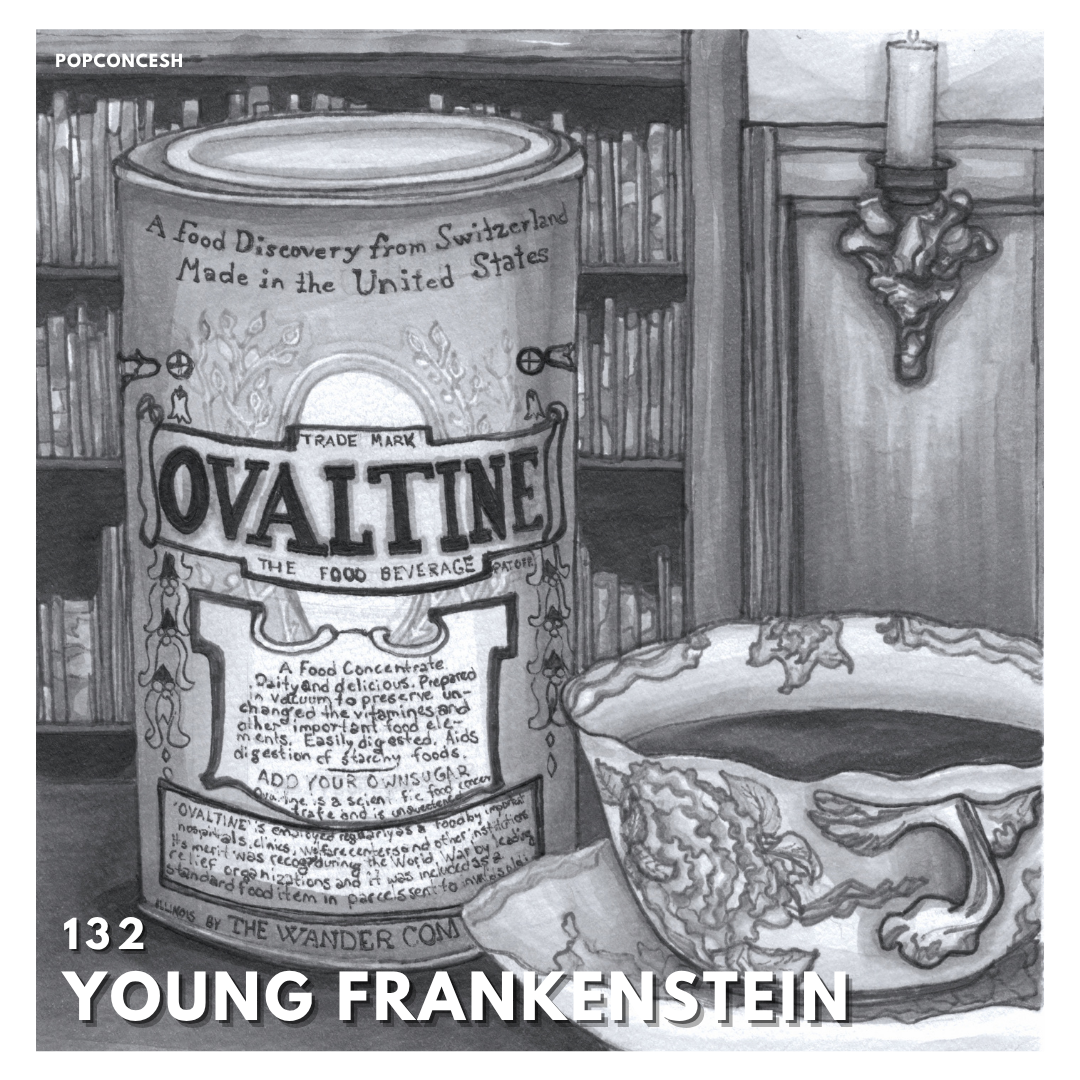
“Ovaltine”
Alcohol-based Marker on Paper, 6”x6”, Fall 2026
132: Young Frankenstein, 1974
Before today’s influencer-driven market of nutritional beverages, enriched with collagen, whey, colostrum, or magnesium, the early twentieth century presented a beverage that would become a key pantry item throughout Europe and the U.S.
In 1865, Swiss chemist George Wander developed a nutritional elixir made from malt extract, milk, eggs, vitamin D, phosphorus and cocoa, called “Ovomaltine”. The name was a combination of the supplement’s two key nutrients: eggs (“ovum”) and malt (an extracted syrup from brewer’s barley).
By 1909, the malt concoction had arrived in Britain with an enhanced formula of ingredients (adding Zinc, Iron, Niacin, Calcium, Vitamin A, B1, B2, D, and E), as well as a new name: Ovaltine.
Ovaltine went on to be a part of the post-war, twentieth century cultural zeitgeist, becoming a pioneer in advertising and radio entertainment, gaining prominence as a nutritional ration for British soldiers, and being named the official drink of the 1948 Summer Olympics in London.
In Mel Brooks’ 1974 film “Young Frankenstein”, a satire of Mary Shelly’s literary classic, Victor Frankenstein has arrived at his grandfather’s castle in 1930s Transylvania, where the housekeeper, Frau Blucher, is seeing him to his room. Before bed, she offers him a range of sleep-aid beverages, from whiskey to “varm milk”, concluding with the final option of Ovaltine. While this comedic moment drives home the dissonance between the irritated Frankenstein and unsettling behavior of Frau Blucher, it’s a distinct moment that highlights the cultural prominence of Ovaltine, not only in 1930s Romania, but as an influential reference in 1970s American film.