
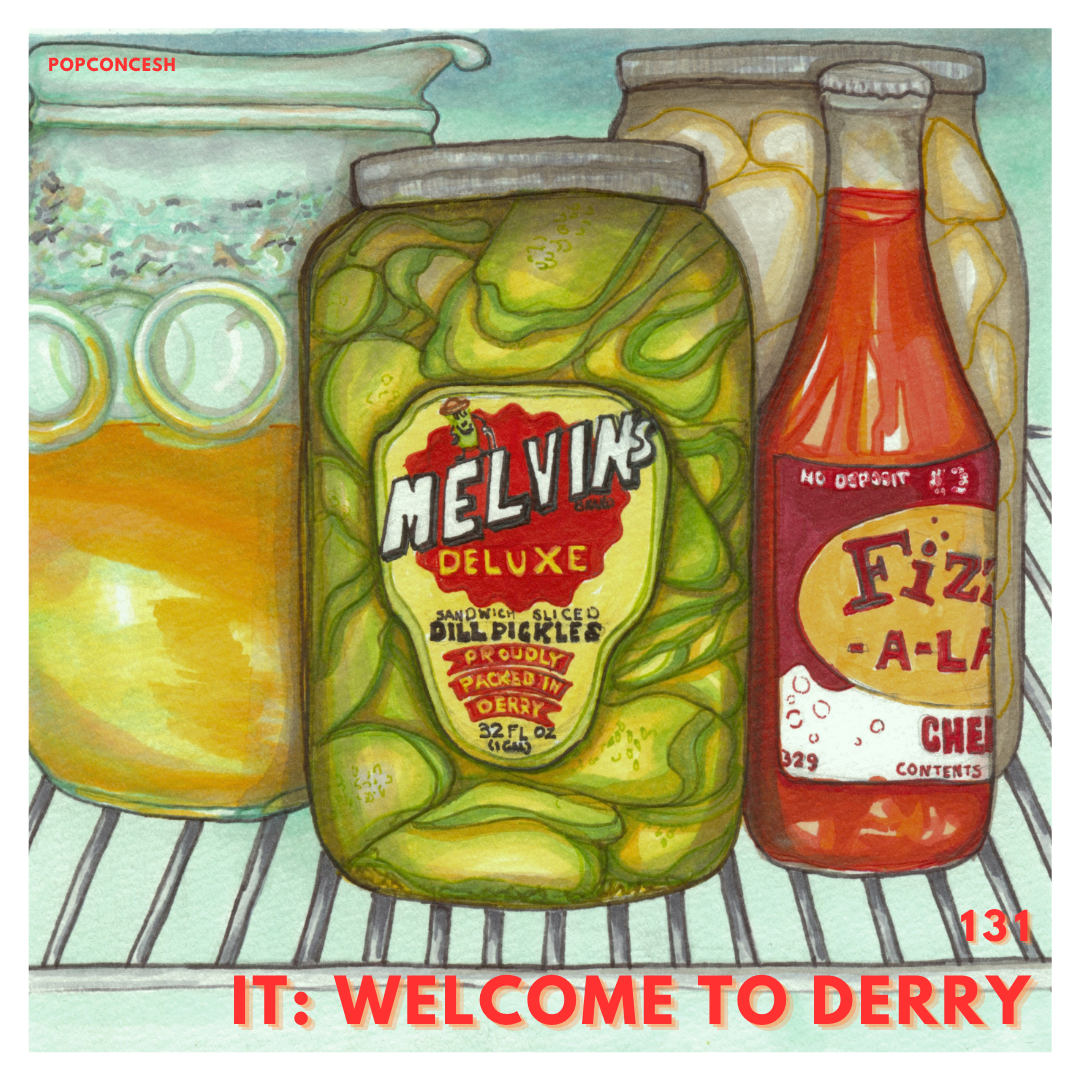
“Proudly Packed in Derry”
Alcohol-based Marker on Paper, 6”x6”, Fall 2026
131: IT: Welcome to Derry, 2025
The ancient and storied history of the “pickle”-a cucumber simply fermented in a seasoned vinegar brine-entered twentieth century America as a championing staple in times of war, economical strife, and an industrial boom.
As the U.S. government established the regulation and rationing of the food market during World War II, 40% of the country’s pickle production was allocated to the armed forces as a nutritional treat. Once the war ended, the pickle industry navigated the “Post-War Pivot”, in which companies were faced with a large surplus of industrial pickling facilities, and were required to pivot in consideration of the modernized, post-war consumer.
By the late 1950s, the evolution into mechanical harvesting had begun due to agricultural labor shortages, which then led to the “Fresh-Pack” Revolution, moving away from open-air fermentation tanks towards individually jarring the cucumbers in vinegar brine directly as a “fresh-pack” method. Once companies, such as Mrs. Klein’s Pickle Co., began to lock exclusive contracts with burgeoning fast-food chain restaurants, pickles had been reinvented as the crisp, tangy garnish within mid-century, American culture.
In the series “IT: Welcome to Derry”, a prequel to Andres Muschietti’s films based on Stephen King’s 1986 novel “It”, the cultural accent of pickle jars in 1962 small town New England is stylistically embedded within the series’ retro aesthetic. The young character of Lilly carries a tragic association with the pickle industry, due to its connection with the death of her father, a former worker in a Derry jarring plant. Seen throughout the series in grocery stores, in-home refrigerators, and as a source of high school pranks, the integration of pickle jars not only represents a symbol of a character’s trauma, but as a distinct, ubiquitous detail that accentuates the American identity in this period of the twentieth century.